




Elsa Cabrera, executive director, Cetacean Conservation Center, and Juan Carlos Cárdenas, director of the Ecoceanos Center
The results of the recent 70th plenary assembly of the International Whaling Commission (IWC), which concluded on October 3 in Australia, have been wrapped in what is being called a “historic consensus” following the adoption of the Hobart Declaration. However, a deeper analysis shows that its outcomes could in fact mark the beginning of a retreat from its conservation and non-lethal use of cetaceans agenda.
The official narrative has focused on two purported achievements: the adoption by consensus of the Hobart Declaration and – by majority or consensus – of resolutions on whale-ship collisions, strandings, and trade in swim bladders. The assembly’s chair, Australian Nick Gales, called the adoption of the Hobart Declaration “truly significant,” presenting it as the first time the commission “speaks with a single voice above political divisions.” But amid this atmosphere of self-congratulation, the fundamental question should be: what will this consensus means, and how it will be used in the upcoming years?
The Hobart Declaration, or the art of hiding second intentions
Although the Hobart Declaration, also known as the “Trojan whale,” was presented as a simple commemorative declaration for the IWC’s 80th anniversary, Gales stated it was “carefully drafted to avoid giving any party a political advantage.” But it is precisely that apparent neutrality that could freeze any momentum for the IWC to keep strengthening its conservation agenda. Because when a text like this is drafted – deliberately omitting substantive elements for the conservation and non-lethal use of whales – consensus becomes a political tool that should not be ignored. Nor should the possible consequences of its adoption .
GBA: Who controls the flagship of the regional cetacean conservation agenda?
The Buenos Aires Group (GBA)—made of 11 conservationist countries from Latin America and the Caribbean—reaffirmed in August 2026 its support for the proposal to create the South Atlantic Whale Sanctuary, as well as its commitment to the moratorium on commercial whaling and its adherence to the Florianópolis Declaration. The latter, adopted in 2018 by the IWC, set this international body on an unequivocal course toward the non-lethal use of cetaceans.
However, by supporting the Hobart Declaration, the GBA would be showing a troubling change of direction. In practice, its text replaces the GBA’s regional policy with a more balanced vision that includes sustainable use—that is, the possibility of reopening commercial whaling. With its endorsement, the flagship of Latin American conservation appears to be being infiltrated by foreign interests that use whales as a political lever. Consensus, then, is being applied to silence internal dissent and undermine the conservationist spirit that has characterized Latin America over the past two decades.
Sacrificed for Harmony: The South Atlantic Sanctuary Lost Again
Although Gales repeatedly stressed the importance of the IWC exhausting every avenue to make its decisions by consensus, once his controversial victory with the Hobart Declaration was secured, that spirit vanished.
The proposal to create the South Atlantic Whale Sanctuary—led by Brazil—failed once again. It fell four votes short of the two-thirds majority needed for adoption.
It is worth recalling that at the 2024 plenary assembly (Lima, Peru), the proposal came close to becoming reality after more than 20 years of efforts to bring it about. It was lost by a single vote, because the IWC chairmanship, also under Gales, granted voting rights to some countries of the so-called “whaling bloc,” even when they were not yet up to date on their membership dues. This bloc, made up of a number of West African and Caribbean nations with no connection to whaling, participate and promote the pro-whaling policy directed by the long arm of the Japanese diplomacy, in exchange for financial assistance programs.
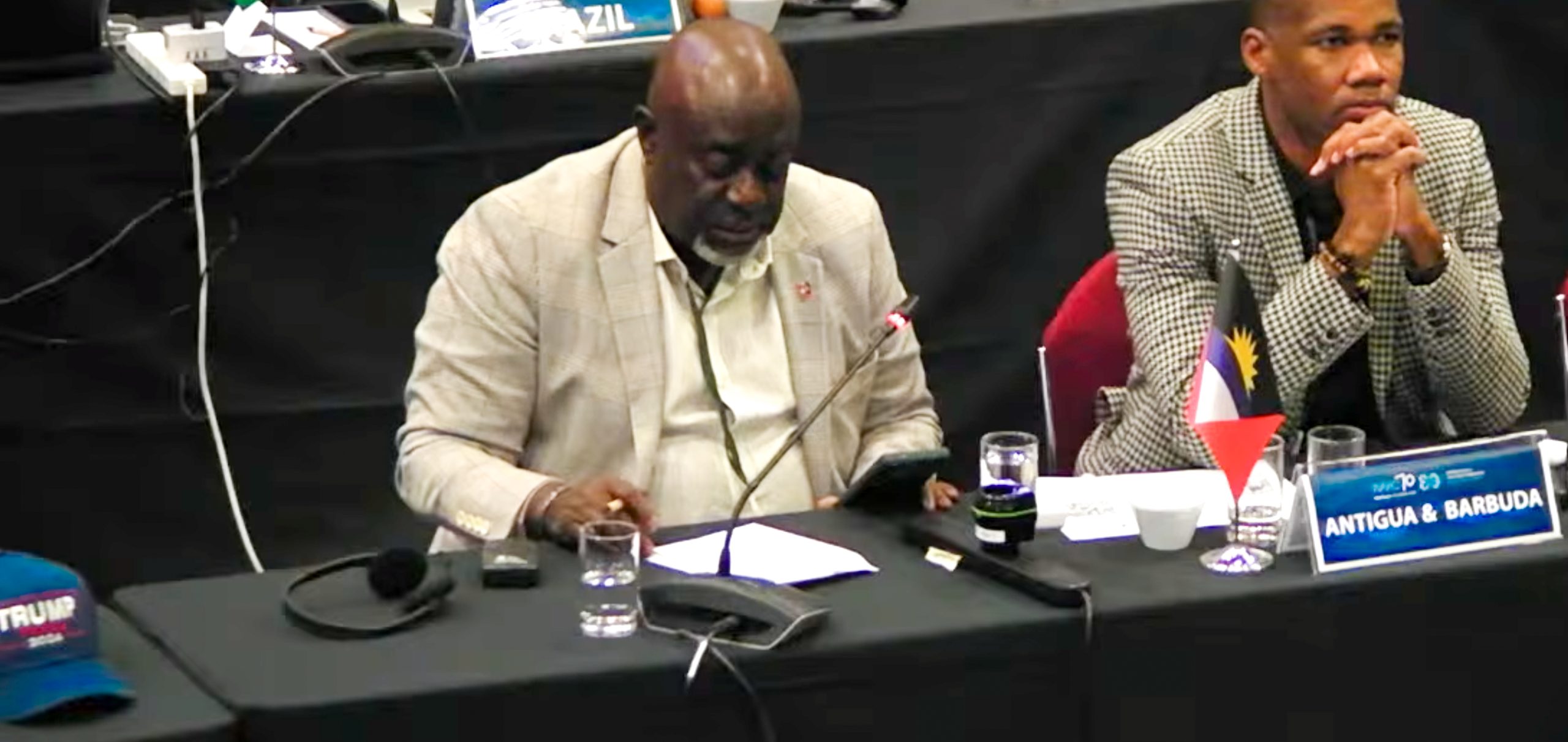
After the vote, Brazil’s representative announced that his country would reintroduce the sanctuary proposal at every plenary assembly until it is accepted. In response, the leader of the proxy “whaling bloc”—the commissioner of Antigua and Barbuda—demanded the permanent withdrawal of the South Atlantic Whale Sanctuary proposal until a review of the moratorium is carried out. This made it clear that the negotiation efforts to reach consensus and harmony within the commission are nothing more than a mirage of agreements. Everything suggests its function is to conceal procedural erosion and to try to strangle the proposal to create the South Atlantic Whale Sanctuary, which has the clear support of a majority.
The U.S. and the whalers’ hemispheric shield at the IWC
This meeting also made clear that the shadow of the Trump regime hangs over the IWC. The United States demanded the removal of key terms, such as climate change, from the Conservation Committee’s work plan, and Argentina, in line with the influence of Javier Milei’s government, abstained from supporting the resolution on swim bladders because it included goals from the United Nations 2030 Agenda on sustainable development. It is striking that Mexico, despite not being aligned with the Trumpist agenda, also abstained, when it is precisely the country that most needs the measures included in the resolution. The fishery for the fish known as the totoaba, to obtain its swim bladders, is the main cause of the imminent extinction of the vaquita, one of the smallest and most endangered cetacean species in the world.
In the current political context, the potential forced reshaping of the Buenos Aires Group is the most disturbing aspect of the last IWC meeting. A growing number of GBA countries now have governments aligned with Trump’s authoritarian regime, thanks to a disinformation network and industrial-scale bot farms that, through algorithms, interfere in democratic electoral processes to install satellite governments loyal to the Donroe Doctrine and the Shield of the Americas.
The silent capture of the Latin American conservation agenda
And under this reality, the GBA as a mechanism for coordinating conservation and non-lethal use policies for cetaceans could begin to be emptied of its content. For while its members reaffirm those commitments, their political systems are being captured by a network of government representatives that uses automated disinformation as an instrument of political domination.
The deeper danger is that the model displayed at IWC70 transforms inaction and submission into hemispheric consensus, while denying such pressing issues as climate change in the name of a subordinated sovereignty. Through it, the political systems of the GBA members will be reshaped by techniques of political manipulation and industrial-scale disinformation campaigns. As a result, our countries and their maritime waters could become a laboratory for foreign geopolitical interests, expressed through new forms of governance in which technology, social control, and environmental management intertwine to impose a model of domination in which whales could become be the first victims. But not the last.
IWC71: The citizen struggle continues in defense of life in our oceans
Forty years after the implementation of the moratorium on commercial whaling, and twenty years after the creation of the Buenos Aires Group, the efforts and the achievements made are under serious threat from procedural issues—such as consensus—and from the normalization of lobbying by a false “whaling bloc” subsidized by Japan, a country that is not even a member of the IWC. Also, by the gradual alignment of the GBA’s regional policy with foreign agendas.