




Elsa Cabrera, Executive Director, Cetacean Conservation Center
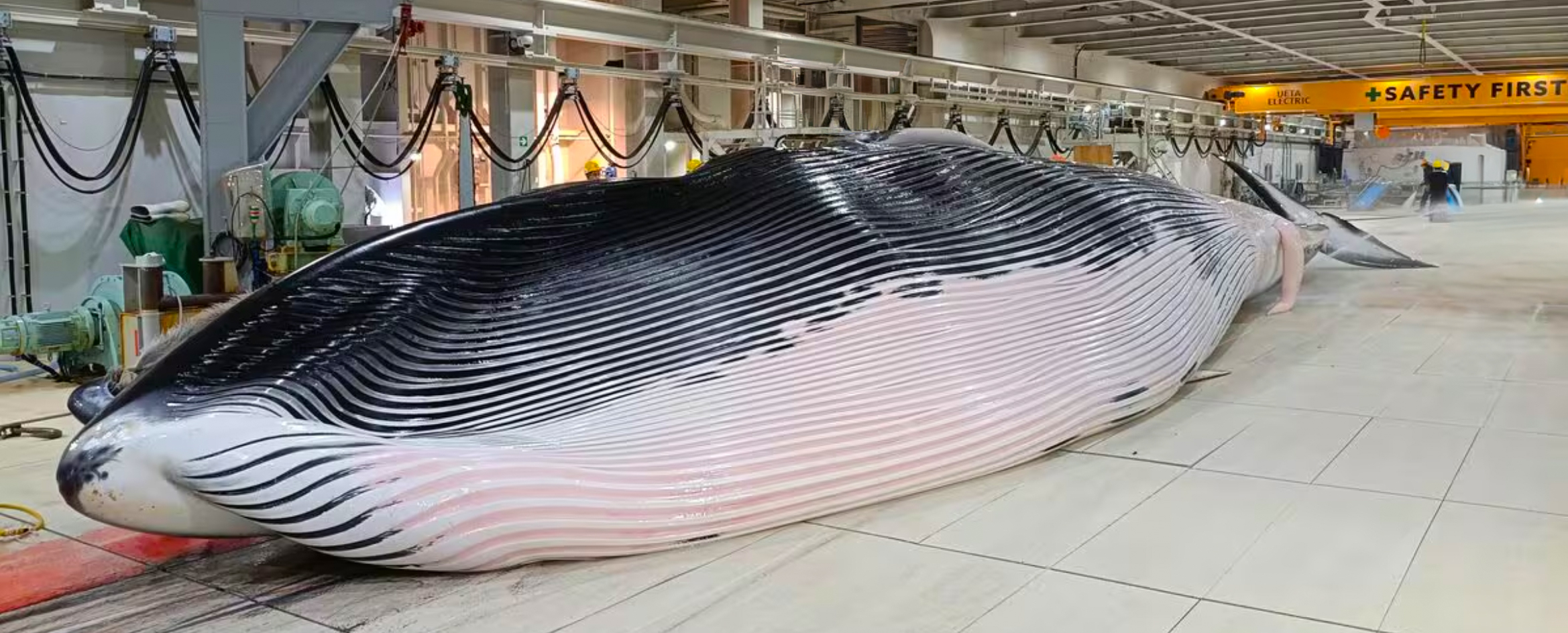
In early December 2025, the Japanese whaling vessel Kangei Maru returned to the port of Shimonoseki after killing nearly 300 whales, including 60 fin whales (Balaenoptera physalus). As the second largest species after the blue whale, fin whales are classified as Vulnerable by the IUCN, having failed to recover from the negative impacts of commercial whaling.
This news is alarming because fin whales are far more than a species that has managed to survive the irrational slaughter of the whaling industry. Their enormous bodies make them exceptional bioengineers that remove carbon dioxide (CO2) from the atmosphere and deliver essential nutrients for ocean productivity.
Therefore, Japan’s resumption of commercial whaling of this species in the North Pacific starting in 2024—following its departure from the International Whaling Commission (IWC) in 2019—poses a serious ecological and socio-economic threat. The slaughter of each of these gigantic marine mammals represents the permanent removal of individuals essential for the functioning of the marine ecosystem, weakening primary productivity and jeopardizing the food systems upon which billions of people worldwide depend.
As bioengineers, fin whales perform three interconnected processes. The first, known as the “whale pump,” is the mechanism by which these gentle marine giants consume krill and small fish in the deep ocean and then rise to the surface to breathe, and also defecate. These nutrient-rich fecal plumes act as fertilization pumps, delivering exceptional amounts of nutrients that are scarce in ocean waters, such as iron and nitrogen. By vertically transporting these nutrients from the depths—where they feed—to the surface waters—where they breathe and defecate—whales play a vital role in fertilizing these waters, promoting the bloom of microscopic algae known as phytoplankton. Despite their small size, phytoplankton is the foundation of the entire marine food web.
The second critical and often overlooked process is known as the “whale conveyor belt,” linked to their urine. Unlike the whale pump, which is vertical and localized to feeding areas, the conveyor belt operates on a global scale during the migration of these large cetaceans. In the case of fin whales, this species travels thousands of kilometers from polar feeding grounds to tropical breeding grounds. Throughout this journey, they excrete large volumes of liquid waste, such as urea and other dissolved nitrogen compounds, into the water. This process acts as a massive, mobile nutrient distribution system that nourishes phytoplankton communities along migratory routes, as well as in nutrient-scarce tropical and subtropical waters. In this way, whales act as true gardeners of the seas, connecting disparate ocean ecosystems and sowing life across all ocean basins.
The third key component of this process has two elements: the “biological carbon pump” and “whale falls.” Whales accumulate tens of tons of carbon dioxide in their bodies over their lifetimes. When they die from natural causes, their remains often sink to the seafloor during decomposition, sequestering all the CO2 accumulated throughout their lives. This gas, responsible for the current climate crisis, becomes trapped in the deep sea for hundreds, even thousands of years. Furthermore, each whale fall creates a complex, localized ecosystem that provides a wealth of nutrients to a host of specialized organisms for decades, promoting and sustaining marine biodiversity. Every harpoon that ends a whale’s life also terminates this natural cycle, which is crucial for ocean life and health.
The justifications provided by the whaling industry and the Japanese government for continuing these hunts—such as the sustainable use of marine resources and cultural traditions—are fatally exposed as erroneous when confronted with this indisputable biological reality. Scientific evidence clearly demonstrates that the contribution of whales to ecosystem functioning far exceeds the economic value of their meat and other products generated by commercial whaling. By killing whales, Japan is not sustainably extracting a marine resource. It is dismantling the very structure that makes the ocean productive. Each whale removed by Japan from the ocean means fewer nutrients to fertilize ocean waters and more CO2 in the atmosphere. The cumulative loss of the contributions of living whales to ecosystem functioning will directly undermine the biological foundation of the fisheries on which Japan and other nations depend.
The relationship between this loss and global food security is as direct as it is urgent. Marine productivity, driven by phytoplankton, is the engine that sustains all fisheries worldwide. Over three billion people rely on fish as their primary source of animal protein, and the socio-economic stability of millions of coastal communities is intimately linked to fishing operations. Thanks to non-lethal whale research, science has now shown that the health of fish stocks depends directly on robust, global primary marine productivity. By decimating key species that enhance this productivity, Japan is destroying the ocean’s ecological capital and reducing its long-term capacity to produce and maintain healthy fish populations.
This threat exacerbates existing pressures on the marine productivity system. On one hand, the climate crisis is increasing ocean temperatures and acidifying its waters, affecting fish populations and causing changes in their availability and distribution. On the other hand, overfishing has pushed most commercial fish species to the brink of collapse. In this context, the deliberate slaughter of key species that fertilize ocean waters is not only dangerously shortsighted but should be classified as a criminal act—an act of ecocide. The decline in primary marine productivity has a domino effect on the entire food web. With fewer nutrients like iron and nitrogen delivered by whales, there will be less phytoplankton to feed zooplankton species (microscopic animals) vital for maintaining healthy fish populations, including commercial fish species for human consumption. The erosion of this food web’s foundation has severe consequences, destabilizing fisheries, increasing catch volatility, and threatening the food and economic security of coastal communities worldwide—from Southeast Asia to West Africa and Latin America.
Contrary to Japan’s arguments, protecting whales—and in this particular case, fin whales—is a powerful nature-based solution for enhancing marine resilience and safeguarding food security. As we now know, robust whale populations act as true mobile fertilization systems. The whale pump recycles nutrients locally in feeding grounds, the conveyor belt distributes them along migratory routes to fertilize ocean waters, and whale falls sequester CO2 and nourish deep-sea species. Demanding full respect for the moratorium on commercial whaling, even from nations not party to the IWC, is not a sentimental, scientifically baseless action as Japanese government representatives often portray it. Rather, it is an investment in ocean productivity and a strategy to sustain all its life forms.
Framing this debate as a confrontation between Eastern and Western cultural values, as Japan suggests, would not only involve ignoring the importance of conserving the global commons of the high seas. It would also serve to progressively dismantle the global nutrient distribution network sustained by whales—a critical and irreplaceable network for ensuring the food security and survival of billions of people whose well-being depends on the healthy functioning of marine ecosystems.