




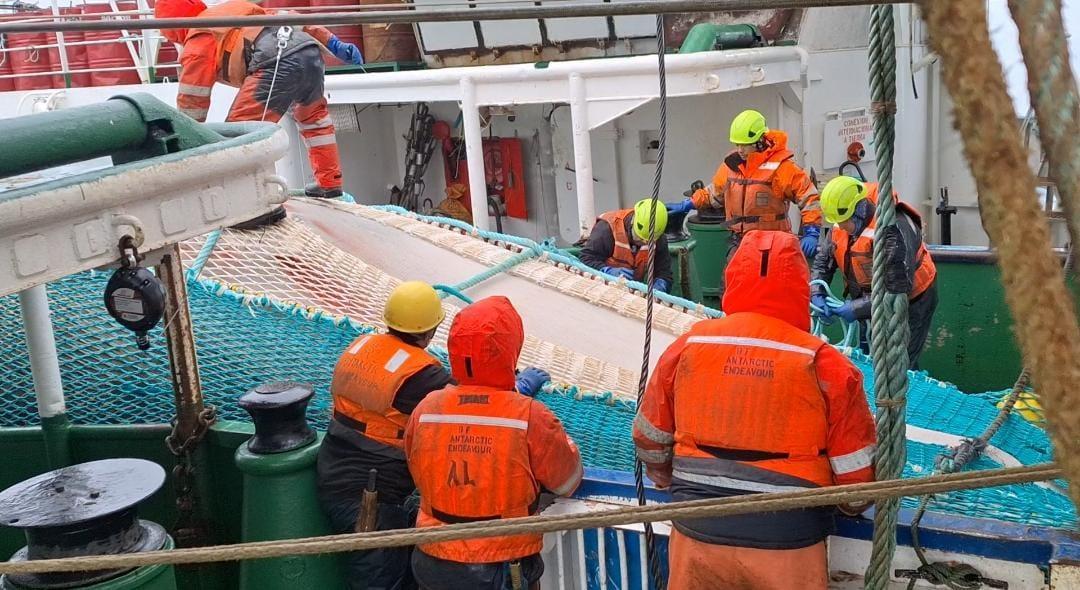
The Cetacean Conservation Center and the Ecoceanos Center have filed a legal protection appeal with the Transparency Council against the National Fisheries and Aquaculture Service, accusing it of acting as both “judge and party” by denying access to key information needed to clarify whale deaths in the Chilean krill fishery in Antarctica.
Santiago, Chile, May 1, 2026 (CCC/Ecoceanos News). In an action described as “systematic opacity and protection of fishing industry interests,” the Cetacean Conservation Center (CCC) and the Ecoceanos Center filed a legal protection appeal on Friday, April 24, with the Transparency Council against the National Fisheries and Aquaculture Service (Sernapesca). According to the marine conservation organizations, the state oversight body only responded partially and selectively to the request for information regarding the death of a humpback whale (Megaptera novaeangliae) in March 2025 aboard the Chilean factory vessel Antarctic Endeavour, owned by the company Pesca Chile S.A., which had already been involved in a similar entanglement in January 2024.
The Request That Never Entered the Transparency System
Following an absolute lack of response from Sernapesca to an initial information request made on November 25, 2025—which the Service itself admitted was never entered into the transparency portal—the organizations submitted a new request on March 19, 2026. This request demanded that the oversight body provide access to the criminal complaint, technical reports, inspection records, the status of the sanctioning process, the company’s mitigation plan, and the level of interaction with the Association of Responsible Krill Harvesting Companies (ARK).
A Partial Response That Does Not Satisfy the Right to Know
Although Sernapesca responded on April 16, it did so only partially, providing information solely on the status of the administrative proceeding and its meetings with ARK, along with four attachments. These include the image review report from the recording device corresponding to the entanglement of a juvenile humpback whale in 2024, reports submitted by Chile to the Commission for the Conservation of Antarctic Marine Living Resources (CCAMLR), and the resolution approving international conservation measures.
However, on the core points of the request, Sernapesca denied access to information, including the criminal complaint, the associated technical report, and the inspection records, arguing that there is an ongoing criminal investigation into the whale death that occurred in March 2025 (under case number RUC 2510017669-9), and that disclosing these records could hinder the criminal prosecution. Furthermore, regarding the mitigation plan of Pesca Chile S.A., the agency neither provided it nor formally stated whether it exists, merely describing the general CCAMLR regulations.
The organizations said that Sernapesca employed a “strategy of delay, obstruction, and legal trickery,” shifting its responsibilities to the courts and the Santiago Prosecutor’s Office, while refusing to disclose information that does not affect the investigation.
“Sernapesca is acting as both judge and party. On one hand, it has already prematurely exonerated the operator of the Antarctic Endeavour before the criminal process has ended. On the other hand, it refuses to disclose the information that would allow civil society and international conservation organizations to verify what actually happened aboard that factory vessel in Antarctic waters in 2025,” said Juan Carlos Cárdenas, veterinarian and member of the Ecoceanos Center.
Article 64J: A Legal Shield Tailored to the Fishing Industry Interests
One of the central points of the citizen complaint is Sernapesca’s use of Article 64J of the General Fisheries and Aquaculture Law (LGPA) to justify the confidentiality and withholding of images from the onboard recording device (DRI) corresponding to the entanglement of another humpback whale in March 2025. However, the organizations note that Sernapesca did provide images of the 2024 bycatch incident in a report with images, demonstrating that the institution selectively discloses information as it sees fit.
Analysis of this audiovisual material would allow marine conservation organizations to learn in detail what happened aboard the factory vessel in March 2025, potentially confirming or disproving the official version. For the 2024 case, Sernapesca released the images and concluded that the whale was returned alive to the ocean, although according to official CCAMLR reports, the specimen was considered a lethal entanglement. For the 2025 case, the images have been declared confidential.
According to Elsa Cabrera, director of the Cetacean Conservation Center, “Article 64J is being used as a legal shield to protect the interests of fishing vessel operators, preventing public scrutiny of what really happened on the high seas during Antarctic krill fishing operations in March 2025.”
This is because Sernapesca used Exempt Resolution No. DN-1139/2026 and Article 64J of the LGPA to deny access to the images contained in the Image Recording Device (DRI), which holds the complete sequence of the so-called “incident” aboard the vessel in 2025, claiming that this information is confidential.
However, the oversight body’s interpretation is erroneous, as it overlooks the fact that Article 64J has two paragraphs. The first declares raw images from the device to be confidential. The second explicitly states that DRI information—once certified by a Sernapesca report—acquires the status of a public instrument and therefore ceases to be confidential.
The Internal Investigation for Information Hiding: A Measure That Does Not Replace Transparency
In its response on April 16, Sernapesca acknowledged that the first information request submitted on November 25, 2025, was never entered into the body’s transparency portal, and extended its apologies for “the omission in providing a timely response to your request.” Attempting to downplay this serious obstruction, the Sernapesca reported that it had ordered an internal administrative investigation “regarding potential responsibilities for what occurred,” without stating who the investigation targets or when its results will be released.
CCC and Ecoceanos argue that this internal administrative measure has no bearing on Sernapesca’s obligation to comply with national legislation and to enforce against those subject to fisheries oversight (vessel operators and their ships) the international commitments and obligations undertaken by the Chilean state.
The MSC Certification: A Seal Complicit in Environmental Destruction in Patagonia and Antarctica
Following the deaths of two humpback whales during krill fishing operations in Patagonian and sub-Antarctic waters by the Antarctic Endeavour, owned by Pesca Chile S.A., the marine conservation organizations state that it is incomprehensible that the Marine Stewardship Council (MSC) has granted a “sustainability” certification to the krill fishery of this questionable company. “The MSC’s role has been that of an active accomplice, providing a false certification for the markets that only whitewashes the image of a company that has been operating with a lethal environmental record in Antarctic waters,” they stated.
A Powerless Sanctuary Facing the Destructive Expansion of the Krill Fishery
In less than fifteen months, the Antarctic Endeavour factory trawler has killed two humpback whales during its krill fishing operations in Antarctic waters. Both lethal interactions occurred in the Southern Ocean, an area designated as a Whale Sanctuary by the International Whaling Commission (IWC) to protect whales from commercial whaling. However, the exponential expansion of industrial Antarctic krill fishing over the past decade—with large trawl nets and cutting-edge technology that capture hundreds of thousands of tons of this crustacean in a single season, right in the feeding grounds of several whale species—highlights the urgent need to strengthen existing controls and conservation measures.
“Whales are not only threatened by becoming entangled and dying in the nets of factory vessels, but their primary food source (krill) is also in danger. Although they are now protected from commercial whaling by the IWC, it is urgent that CCAMLR adopt measures such as establishing a moratorium on the Antarctic krill fishery to prevent overexploitation of this crustacean—which is vital to the Antarctic ecosystem—and to prevent more whale deaths in the Southern Ocean,” Cabrera said.
The Sernapesca/Antarctic Endeavour Case Before the Transparency Council
In the legal appeal filed on Friday, April 24, CCC and Ecoceanos requested that the Transparency Council order Sernapesca to provide the requested documents, redacting only those data that are confidential, so that they may access freely available information such as dates, locations, descriptions of events, the certified DRI report, and inspection records.
They also requested that Sernapesca report whether Pesca Chile S.A. does or does not have a mitigation plan, and that if one exists, it be provided. To date, the state institution has only provided general information on CCAMLR requirements, avoiding addressing the substance of the information requests made in November 2025 and March 2026.
The Transparency Council has 20 business days to issue its decision. CCC and Ecoceanos stated they will monitor the outcome to report back to the public and international bodies.
Public Call
Finally, the representatives of the Cetacean Conservation Center and Ecoceanos called the public to remain vigilant and support the legal appeal filed with the Transparency Council, demanding oversight of the conduct of Sernapesca’s National Directorate, respect for the citizen right of access to public information, and the application of corresponding sanctions against the actions of Pesca Chile S.A., owned by José Luis Del Río, one of the most powerful and influential businessmen in the country, who is part of the seven economic groups that own Chile’s fisheries.