




Elsa Cabrera, Executive Director, Cetacean Conservation Center
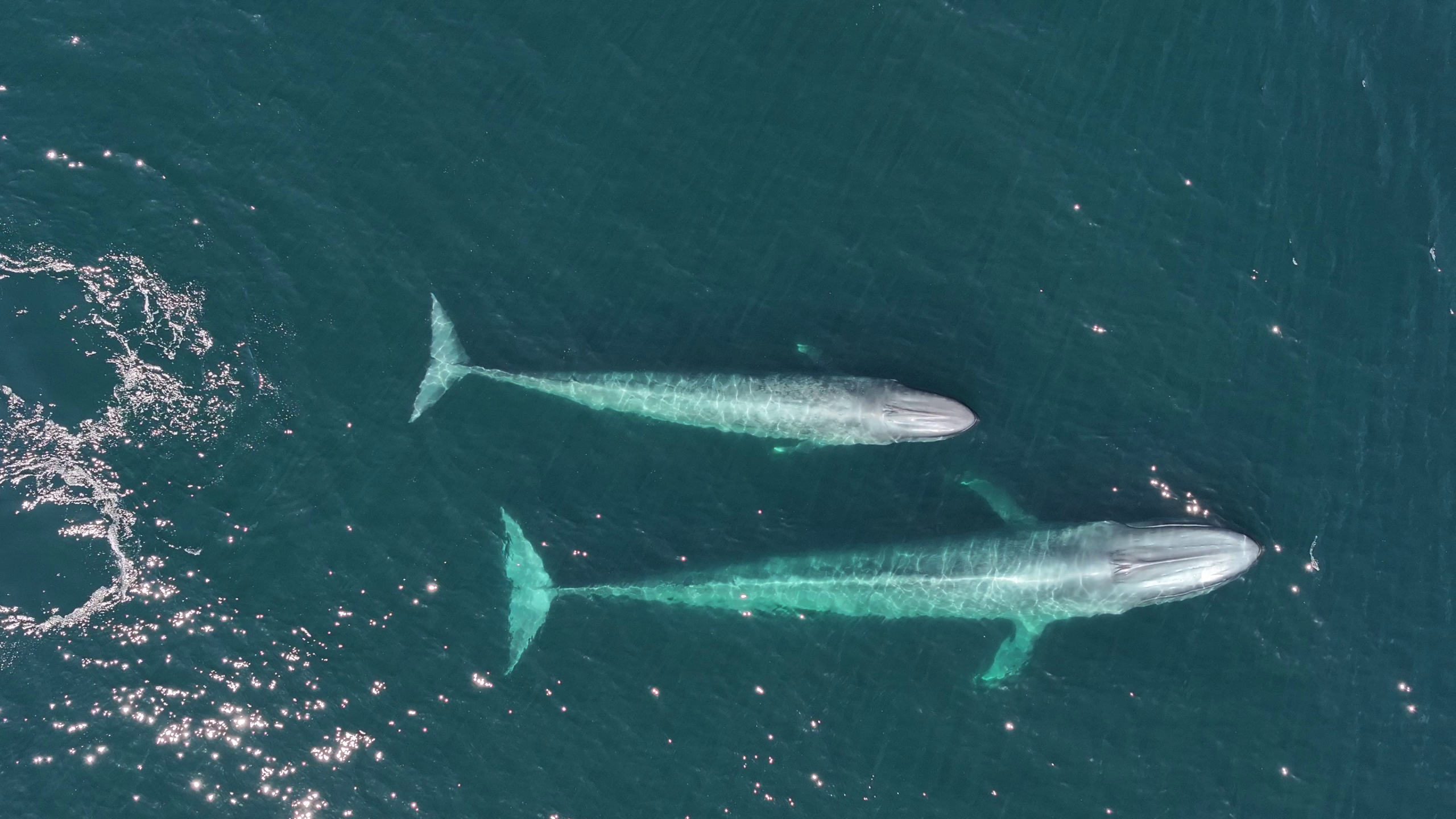
In the rich waters of Chilean Patagonia lives one of the most unique populations of blue whales (Balaenoptera musculus) on the planet. Every year during the austral summer, the northwest coast of Isla Grande de Chiloé becomes the home of these gentle marine giants, arriving to feed on a small crustacean known as krill. After decades of research, we now know that the whales’ fidelity to this site runs far deeper than previously believed.
A study published last week in the prestigious scientific journal Marine Mammal Science, led by Chilean researcher Bárbara Galletti of the Cetacean Conservation Center, confirmed that these whales are remarkably faithful to their feeding grounds. The study, which analyzed over a thousand individual photo-identifications of blue whales collected in Chile, Peru, Ecuador, and the Costa Rica Dome between 1992 and 2019, also demonstrated the migratory route connecting southern Chile with the Galápagos Islands.
Unwavering Fidelity
One of the study’s most significant findings is the extraordinary fidelity blue whales show to their feeding area in southern Chile. Of the 758 whales photo-identified between 40 and 44 degrees south latitude, the average annual return rate reached 43 percent. Additionally, the longest time span between the first and last sighting of the same individual was 17 years, highlighting the long-term importance of the area for these animals. This whale was first photographed in 1998, then sighted again in 2008, and later in 2015 in the same study area.
Among the most emblematic cases is a whale named Valentina, the most frequently sighted individual, recorded on 11 occasions over 10 years, and Moro, a whale sighted both off Chiloé Island and in the Gulf of Penas—the southernmost known record for this population.
This high fidelity is no coincidence. The northwest coast of Isla Grande de Chiloé is internationally recognized as a critical feeding ground for the Chilean blue whale—a subspecies not yet formally named, but distinct in morphology, genetics, and acoustics. During the austral summer, these marine mammals—the largest species ever to have lived on Earth—gather there to feed and build energy reserves for the rest of the year on one of the world’s smallest marine species: krill.
Blue Whales in Northern and Southern Chile
Data analysis also revealed that blue whales recorded around Chañaral Island in northern Chile (Region IV) show a preference for that specific area, but their annual return rate is lower (8%), with time spans of up to 13 years. These results suggest that blue whales arriving in the north prefer to return to that zone, while those reaching Patagonia return more consistently to their critical feeding area around Isla Grande de Chiloé.
The Migratory Route to the Galapagos
Thanks to the analysis of scientific data collected over two decades, the study also confirmed the migratory connection between whales feeding in southern Chile and the Eastern Tropical Pacific. Photo-identification once again played a key role. One individual photographed in November 1998 near the Galapagos Islands was later resighted in 2006 and 2008 in the Corcovado Gulf, over 5,200 kilometers away. Another blue whale, photographed south of the Galapagos in 2003, was sighted three times off northwest Isla Grande de Chiloé in February 2006 and 2008.
These findings confirm that the Chilean blue whale undertakes a northward migration during the austral winter, heading to the warm waters of the Eastern Tropical Pacific—likely to breed or give birth—and returns to Chile in spring and summer to feed. This pattern aligns with previous studies on acoustics, genetics, and satellite telemetry, data now backed by individual confirmation through photo-identification.
Science for Conservation
Knowledge of this migratory route and the Chilean blue whale’s fidelity to its feeding grounds becomes critically important in light of an alarming fact. According to a study published in Marine Policy (2025), Chile has one of the highest rates of whale mortality due to ship strikes in the world. The study’s results indicate that blue whales account for 11% of the mortal strikes, and one of the regions with the highest incidence of collisions includes the feeding area in southern Chile.
Faced with this reality, Chile has a legal tool that must be strengthened to protect this emblematic species, whose health is essential for the functioning of the marine ecosystem. The law 20.293, also known as the Chilean Whale Sanctuary, was enacted in 2008 following a successful campaign led by the Cetacean Conservation Center and the Ecoceanos Center. It establishes a regulatory framework for the protection of all cetacean species in Chilean waters, including the creation of marine protected areas in critical zones for these species.
According to Bárbara Galletti, President of the Cetacean Conservation Center, member of the Scientific Committee of the International Whaling Commission, and lead author of the study: “The results show that the waters of Chiloé are indispensable for the recovery of the Chilean blue whale. In this regard, it is necessary to protect the blue whale feeding area from evident threats in Chilean Patagonia, such as ship strikes and unsustainable salmon farming growth. Binding measures must be established to prevent ship strikes, entanglement in fishing nets, and chemical pollution, along with exclusion zones that also protect the entire marine food web.”
Following the publication of these results, achieved through collaborative work, translating them into concrete conservation actions is no longer a technical or economic challenge—it is an urgent and unavoidable decision. All that is needed is political will, so that those in power ensure the whales’ fidelity to our waters is met with Chile’s commitment to their long-term conservation and recovery.